
Sayeed Al Mesbah, Dhaka
“I always thought a road is named after someone who must be well-known or important. But honestly, I don’t know why this person is famous or what they actually did.”
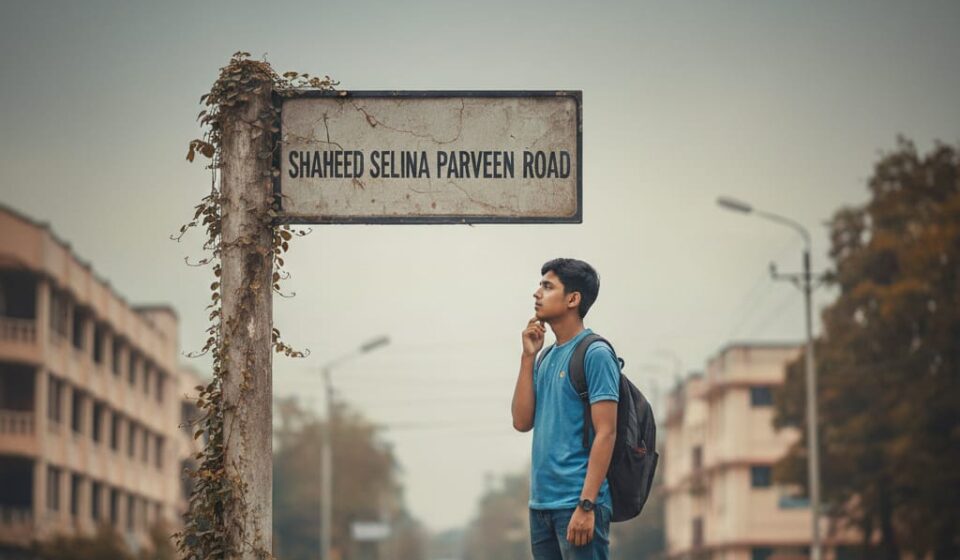
These words came from Sakib, a 17-year-old college student who lives on Shaheed Selina Parveen Road in Feni. He walks this road every day on his way to college, yet knows little about the person after whom the road is named.
Martyr journalist and poet Selina Parveen published the magazine Shilalipi in 1969. During the Liberation War, its covers and writings became a source of irritation for the Pakistani army and their local collaborators, the Razakars.
At the same time, she actively supported freedom fighters in Dhaka in various ways. Because of these activities, her name was listed by the Al-Badr Bahini.
On 13 December, 1971, members of Al-Badr picked her up from her home in Siddheshwari. The next day, 14 December,, when Al-Badr killed a large number of intellectuals at the Rayerbazar killing ground, Selina Parveen was among them. Her body was found there with her eyes tied.
She was buried at Azimpur graveyard on 18December. Selina Parveen was born on 31 March,1931, in Feni.
When Sakib was told these facts and asked if he knew of any other intellectuals from his own district, he could not recall any name except Zahir Raihan.
Explaining why he knows only Zahir Raihan, Sakib said, “I read about him in books when I was in school and heard about him from my teachers. I know he was a filmmaker, but I’ve never watched any of his films.”
But Zahir Raihan was not only a filmmaker. He was also a novelist and short story writer.
He began his career as a journalist at Juger Alo newspaper in 1950. He was actively involved in the Language Movement and was present at the historic Amtala gathering on 21 February. The movement deeply influenced him, which is clearly reflected in his famous film Jibon Theke Neya.
On 30 January, 1972, after receiving news that his brother Shahidullah Kaiser and others were being held captive by Biharis in Mirpur, Zahir Raihan went towards Mirpur-12 with an army and police convoy in the morning.
Around 9:30am, Biharis opened fire on the army and police near the Kalapani water tank. Zahir Raihan was killed in the firing. Although Mirpur was freed from Bihari and Pakistani forces the next day, 31 January, his body was never found.
This picture is not unique to Sakib. Similar lack of awareness is seen among many from the new generation, often called Gen Z and Gen Alpha. Blaming only this young generation for not knowing about the martyred intellectuals of 1971 would miss thr bigger picture.
Zahir Raihan was born on 19 August, 1935, in Majupur village of Nawabpur Union under Sonagazi upazila in present-day Feni district. Yet, even 54 years after independence, there is little visible effort in Feni to preserve his memory.
In the city’s Mizan Road, in front of the District Council building, once stood the “Shaheed Zahir Raihan Auditorium.” During the 1970s and 1980s, many stage plays written by theatre legend Dr Selim Al Deen were performed there and left a strong impression on audiences.
However, the auditorium was demolished 17 years ago. The only structure in the city connected to Zahir Raihan’s memory no longer exists.
Former coordinator of Feni Theatre, Kazi Iqbal Ahmed, said, “After the demolition of the auditorium, theatre practice in Feni has become stagnant. Theatre maestro Selim Al Deen and filmmaker Gias Uddin Selim also staged plays at this auditorium.”
In this context, young Sakib told this reporter that he now plans to learn about these intellectuals by watching videos on YouTube.
In today’s world, those who practise intellectual work, write, and create video content are also intellectuals of this time.
To understand what today’s youth think about contemporary intellectuals, this reporter spoke to a university student, Mujahidul Islam Joy.
He said, “The intellectuals of 1971 and earlier times left their thoughts, values and protests against injustice through their work, just as Zahir Raihan did through his films. Those works added such value that we are still talking about them even after 54 years.”
He added, “But among today’s intellectuals, who regularly speak and write about society, politics and current issues, this is often missing. In most cases, they remain focused on personal or political agendas. Protest through work and commitment to principles are no longer there. The honesty and dedication seen among the intellectuals of 1971 are largely absent today. Many have sold out.”
Knowing defeat was inevitable, on this day in 1971, 14 December, the Pakistani occupation forces and their collaborators including Al-Badr and Al-Shams brutally killed Bangladesh’s leading intellectuals in cold blood.
Two days later, on 16 December, the Pakistani forces surrendered and accepted defeat. Though there was no military necessity, the killings were carried out to weaken Bangladesh intellectually.
After the final victory of the Liberation War, mutilated bodies of intellectuals with tied eyes and hands were found at Rayerbazar brickfield, Mirpur execution site, and in different places across Dhaka and the country. Many remained missing, their whereabouts never known.